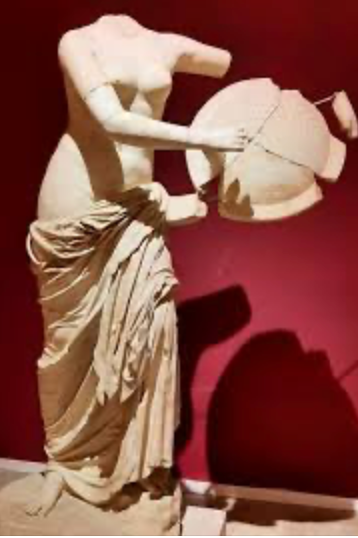
As someone who has been religiously visiting archeology museums around the world for the past ten years (literally, since 2014)(+ an archeology student, so I can claim to have a valid opinion about the subject matter); I think Antalya Archeology Museum is among the coolest ones I have visited. Yes, even cooler than the Istanbul Archeology Museum.
Anyways, coming back to the topic. While I was at the museum, I saw a statue that moved me more deeply than anything else. It was of Aphrodite, holding a battle shield. One might ask at this point, what is so special about a random statue of the goddess of love? It was the shield that mattered for me.
If she is purely the goddess of beauty, love, and lust… Why would they carve her holding a battle tool? This is the exact spot where my research began, on proving that Aphrodite was honored as a goddess of war. As a matter of fact, many of her attributes recall the ancient Middle Eastern goddess Ishtar (she is the goddess of war and sexuality in Mesopotamian myths, ‘she, who vanquishes all’). So, the point I must stress here is that Aphrodite might not be a native goddess in Ancient Greece (I mean, the ancient societies are known for borrowing and changing one another's beliefs, so this is not a shocker). Thus, she was not born from the Aegean Sea as it was represented by Botticelli, but an immigrant coming from the Near East, which is almost the same geography, yet a different cultural group.
Further in my research, I have come across the cult “Aphrodite Areia” also known as “Aphrodite the Warlike”. In this cult, Aphrodite would be depicted in full armor, just like Ares. This representation was generally found in Sparta and Taras, both of which are ancient cities of Greece. This statue of Aphrodite with the Shield that was found in Antalya might be coming from some sort of an extension of the cult. With that being said, in Cyprus, people would refer to Aphrodite as “Aphrodite Encheios,” which initially means Aphrodite with a spear.
However, Homer draws a whole different image of Aphrodite in the Iliad. Her wrist/hand gets wounded, depicting that she is useless during a battle and is later confronted by her ‘father,’ Zeus. In the transition from Ashtar to Aphrodite, the birth story told by Hesiod stresses the heavenly side of the goddess by telling us that Aphrodite was not born by the white foam of the Aegean Sea but rather from the white sperm of Uranus- depicting Uranus (Heaven) as her father, just as Ishtar’s father was Anu (Heaven). Which goes against of Homers’ depiction of a gentle daughter of Zeus and turns her into one of Zeus’ aunts.
Bettany Hughes, a British historian who wrote “Venus and Aphrodite” (which is a book recommendation by the way, guys, you should read!!), had her ideas about the change of Aphrodite. She believed that the representation of Aphrodite had its’ downfall at the same time as Homer, in other words, as the downfall of representation for women. Since in Homeric times Greek women were experiencing social restrictions, represented as women, Aphrodite as well lost her complexity. You might think, in this case, if women were not cared about, why was Athena such an important character in Greek mythology? Well... Generally known as the "patriarchal daughter," Athena's story is slightly different, and I will be explaining it in another essay, so don't forget to check my page for that as well!
So, the conclusion that came from here is that, by her Middle Eastern connections, Aphrodite could be the goddess of war, and she was worshipped as such in Cyprus. However, in many Greek cities, this qualification of hers disappeared over time and left Athena and Ares as the duo of war.
In my opinion, even without her spear or shield, even by purely being the ‘goddess of love and beauty’, it is not possible to underestimate Aphrodite’s power and her role in wars, as she was the main reason for ancient Greece’s most important war: The Trojan! (Remember, she was the one who offered Paris the most beautiful woman in the world, an already married lady, and the battle started when Helen got kidnapped/ or left willingly with Paris- a changing interpretation based on different sources)